We matched the cars that sold at auction to the dealer lots they turned up on, by VIN, and followed what happened to both. The lot asks about a fifth more than the auction paid, the auction is still cheaper after fees and shipping 97% of the time, and waiting for the dealer to come down does not work. The honest half is that the dealer's premium buys real things, and we priced those too.
Every buying guide says the same two things: go to auction and you overpay in fees, go to a dealer and you overpay in margin. Motorious said it this month: "neither format guarantees a bargain." We can say which one does, car by car, because we see both markets for the same 54 cars: every enthusiast-car auction result since 2019, about 26,000 of them, and a daily snapshot of every dealer and classified listing of those cars, about 8,000 at a time.
Three things were measured. First, the same car in both places: a car sold at auction whose VIN later appears on a dealer lot, with the days between, the dealer's asking price against the hammer, the hammer against our fair value, and what the car was asking when it left the lot. Second, the dealer lot on its own: how long cars sit, when and how much they are cut, what asking price makes a car leave, and whether dealers ask more on cars that are rising. Third, dealers inside the auction: what a dealer-consigned car brings against a private seller's car for the same model, year and miles, how often it sells, and what happens when the buyer sells it on. Every comparison is made inside one car before anything is pooled, with model year, mileage and the month of sale held equal, and every finding says how many of the 54 cars agree. Where two ways of measuring disagreed, both are printed.
Fair value is what an exact car, with its miles and spec, should sell for at auction today. Here is the full method. Dealer prices in this report are asking prices, which is what a buyer faces; what a lot car finally sells for is seen only where the same car later came back to auction, and section 3 treats the last ask as a ceiling. The lot figures come from two weeks of daily snapshots in October 2026; the auction figures from the full record.
Most cars sold at auction go home. But of the 3,788 cars sold at auction in the last twelve months, 152, one in 25, have since turned up on a dealer lot, and that is a floor, because we only watch each lot for two weeks. Those 152 are the cleanest test there is: the same VIN, bought at auction and put on a lot. They were listed a median 40 days after the sale, with a median 92 more miles, asking 26% more than the car had just sold for. It held on 47 different cars.
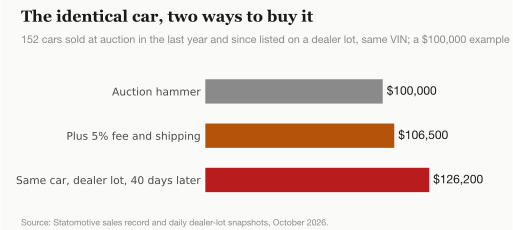
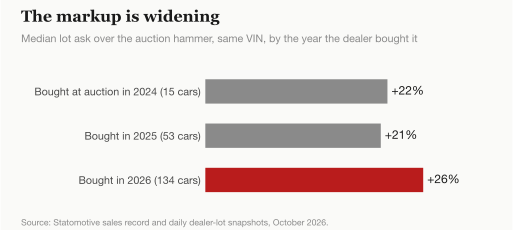
The dealer did not steal the car. Those hammers sat a median 3.7% under our fair value, which is to say they paid the going price. The 26% is a retail layer on top of it, and it is widening: 21% on cars bought at auction in 2024, 26% on this year's. Widen the window to every such pair we can see, 233 cars going back to 2021, and the median markup is 22.5%.
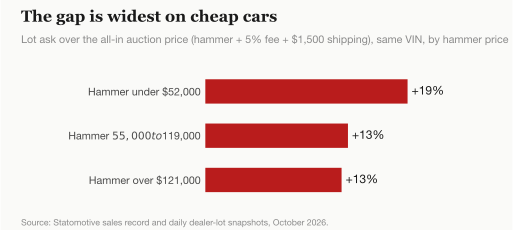
Fees do not close the gap. The three big online auction sites now charge the same buyer's fee, 5% of the hammer capped at $7,500. Add that and $1,500 for an enclosed truck, and the auction was still cheaper for 147 of the 152 cars, by a median 21%, about $19,700 on the typical car. The gap is widest on cheap cars, 19% over the all-in auction price under $52,000, and narrowest on expensive ones, 13% over $121,000, because the fee cap and the shipping are a smaller share of a big number.
A car that failed to sell at auction follows the same path. Of 151 cars whose reserve was not met and which then appeared on a lot, the dealer asked a median 28% over the bid the seller had refused.
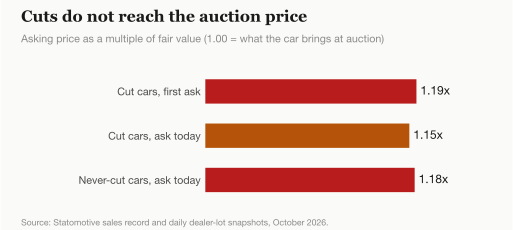
The standard advice is to let a car sit. On these cars the lot does not behave that way. The first price cut comes at a median 14 days and is about $1,000, 1.6% of the ask. Then the cutting slows: a car that has sat 180 days gets fewer cuts per month than one at 60 days, not more. Of the cars listed over 90 days, 39% ask the same or more than they did on day one, and 22% ask more than 2% above it. The cuts do not reach the auction price either: cut cars start at 1.19 times fair value and are asking 1.15 times it today. Only 17% ever go under fair.
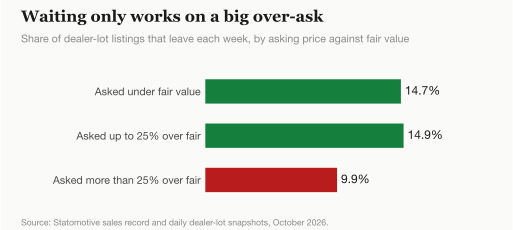
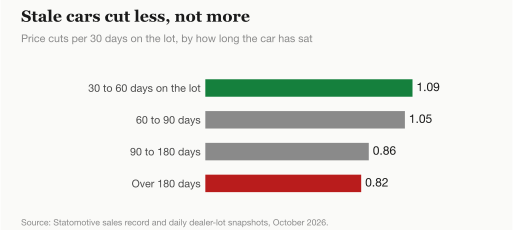
Over the two weeks we watched, 10 to 13% of listings left the lot each week, and the rate was the same whether a car had sat one month or six. Asking under fair barely speeds a car up. The only thing that slows one down is asking more than 25% over fair, and even those clear at 10% a week. What leaves the lot leaves asking about 5% above what the same car brings at auction. The median listing has been up 50 days; 30% have been up more than 90; 56% had been listed before, taken down, and put back. And 45% of cars that sit 60 days or more show more miles on the clock later in the listing.
Only 2 of the 1,730 lot cars that disappeared during our two weeks turned up at auction afterward. The lot and the auction block are nearly separate populations: a car that leaves a lot was bought off the lot.
Everything above compares an asking price to a hammer price, and the obvious objection is that the ask is not a wish: somebody pays it, or the car would still be there. Our snapshots say that is mostly right. Of the 233 same-VIN cars, 33 had left the lot by our last snapshot. They left asking a median 20% over the hammer, and within 1% of their own first ask, which is to say without a cut. The 196 still listed ask 25% over. Across every lot listing we watched, what left asked a median 5.5% over the car's own 12-month auction median and 1.14 times fair value; what stayed asked 8.4% over the auction median and 1.16 times fair. The lot clears at about 5% over the auction, from the middle of the price range, not from the cheap tail, and it clears fast: half the lot turns over in about five weeks.
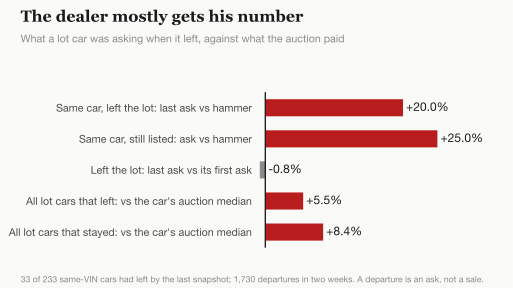
The cars that did get cut tell the same story from the other side. Of the lot cars that vanished after at least one price cut, the last ask still sat a median 9% above what the same car, model year and mileage band had been hammering for; one in three was under that hammer, and 44% were under the auction price once the fee and the shipping are added. So a dealer who cuts and then sells has, about a third of the time, matched the auction. The dealer who never cut has not.
What we cannot see is the figure on the contract. A listing that disappears is a last ask, not a sale. Of the listings that vanished in our first three days, 29% were back up eleven days later, withdrawn and relisted rather than sold, and the price paid on the rest can only be at or under the ask. The one place we observe a lot car's real sale price is when the dealer gives up and sends it to auction: there it hammers a median 9% under his last ask, below the ask 87% of the time. Read the 22% as the dealer's number, usually close to what the buyer paid, and as a ceiling. The question this report answers is not whether that price is real. It is whether you should be the buyer who pays it.
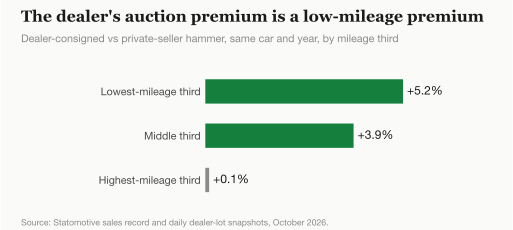
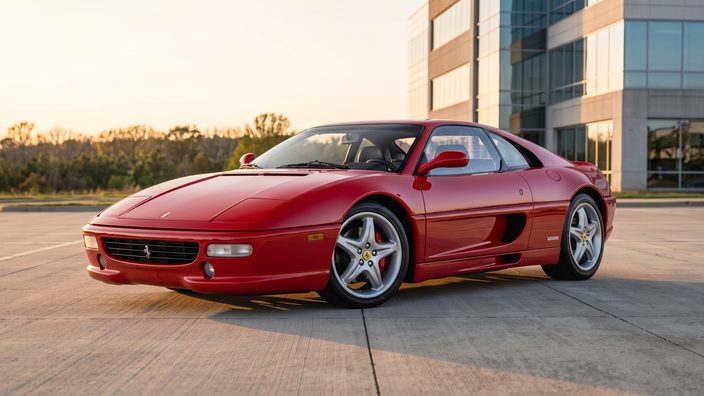
Here is the number that surprised us. Inside the same car, same model year, same miles, same month, a car consigned by a dealer hammers 4 to 5% above a private seller's. That held on 46 of 54 cars and is biggest on the Ferraris, at every mileage: a dealer-consigned F430 brings 18% more, an F355 17%. Pooled over all 54 cars and split by each car's own mileage thirds, the premium fades with miles: 5% on the lowest third, 4% in the middle, 0.1% on the highest. That reads as the presentation and the reconditioning being paid for, not the badge on the seller. The two Ferraris do not agree with each other on it, so both are printed. The F430 follows the pooled pattern: 26% on its lowest third, under 11,300 miles, 14% in the middle, 7% over 21,000 miles. The F355 goes the other way: 13% under 22,000 miles, 8% in the middle, 29% over 32,300 miles, with about 95 sales in each third. One reading is that on a 30-year-old car it is the dealer's service history, the belts and the clutch, that the buyer pays for, and a high-mileage private F355 does not come with it. We have not tested that.
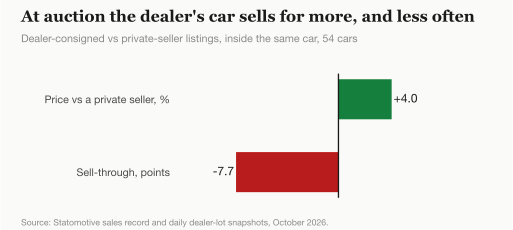
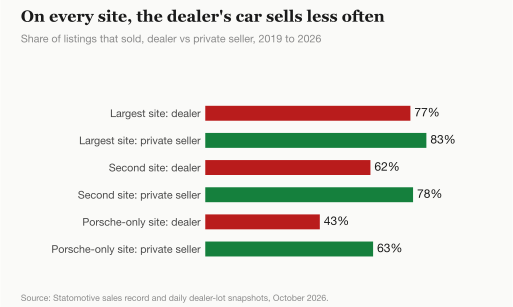
But a dealer's car also fails to sell more often: 73% of dealer listings sell against 81% of private ones, on every site we track, and the gap holds on 49 of 54 cars. Dealers set higher reserves. When a dealer's car does not sell, the dealer relists it in a median 52 days; a private seller takes 104.
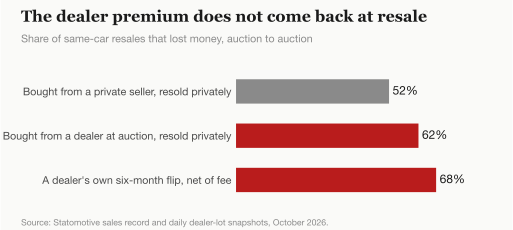
Then the part a buyer should know. We followed every car that sold at auction twice. A car bought from a dealer at auction and resold privately later lost money 62% of the time, a median 4.3%. Bought from a private seller and resold the same way, 52%. A dealer's own quick flip, bought and resold inside six months, lost money 68% of the time once the entry fee is counted. The dealer premium is real at the block, and it does not come back at resale.
If you want to learn more about the values of these cars, click the guides below.
This is the honest half, and the record supports it more than we expected. A dealer sale carries protections a private auction sale does not. The FTC's Used Car Rule binds anyone selling more than five cars a year to the Buyers Guide; thirteen states and the District of Columbia restrict a dealer from selling as-is at all; Massachusetts gives a dealer-sold car a 30 to 90 day warranty by law; title-delivery deadlines bind dealers only. A private seller owes you an odometer statement and the truth, and almost nothing else. The auction sites write themselves out of the deal: not a party to the sale, no inspection, no refunds, binding arbitration. We looked for a reported court win by the buyer of a misrepresented auction car and found none, only withdrawn listings, banned sellers and partial fee refunds.
The dealer also sells certainty. One auction listing in five ends with the reserve not met, so the car you spent a week on may not be yours. A pre-purchase inspection on an exotic runs $550 to $900, an enclosed truck across the country about $2,100 to $2,500 and a week or two, and you arrange both in a city you are not in. A dealer gives a drive first, a trade-in that cuts your sales tax in most states (the credit is dealer-only almost everywhere, and three states give none), financing over ten or fifteen years on a car no bank wants, and a car that has been reconditioned, about $1,679 a car by the industry's own figure. The doc fee is the small part: $85 in California by law, about $999 in Florida, where there is no cap.
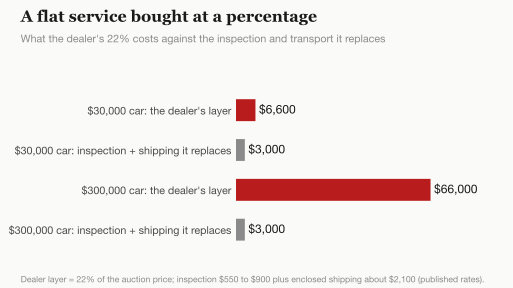
Put a price on it. For a $30,000 car the dealer's layer is about $6,600 and the services it replaces cost $3,000 or more: worth paying for a buyer who wants one trip and a warranty. For a $300,000 car the same services cost the same $3,000 and the layer is about $66,000. The premium is a flat service bought at a percentage.
We expected dealers to front-run the auction: to ask the biggest premiums on the cars that are rising fastest. Whether they do depends on what you measure the ask against, and the two measures gave different answers.
Measured against our fair value, which is today's price, dealers do not front-run. On a car whose auction price rose 10% over the year, the lot asks about one point more over fair than on a car that did not move. Measured against the car's own recent sales, the last 18 months of results that anyone can look up, they do: on that same rising car the lot asks six points more over the comps.
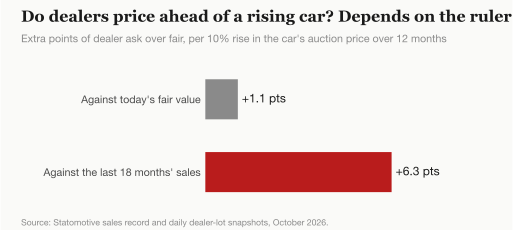
Here is why both can be true. A dealer prices a rising car at what it sells for today. The recent sales are from before the rise, so they sit below today's price. Measured against those older sales, the ask looks high. Measured against today's price, it looks normal.
For a buyer it comes to this. On a rising car, your own research will make the dealer's ask look expensive, because the sales you find are from before the rise. The dealer is not ahead of the market. The sales you found are behind it. That is why fair value has to be computed from the market as it stands, not looked up from last year's results. The one measure that would settle which reading to trust, the ask against the last 90 days of auction sales, we have not run yet, so both are printed.
Almost nowhere, and we say that having gone looking. The lot looks cheap on four cars: the Aston Martin V8 Vantage, the BMW E46 M3, the Lamborghini Gallardo and the Lexus LS430. On three of them the cheap listings are the ones that do not say which gearbox the car has. That is most of the lot: 58% of the 8,325 listings we priced this week name no gearbox, because the dealer feeds do not carry it, and a dealer's "Manual" tick with no words behind it is not believed, since people write manual to get clicks. On a car where the manual is worth 10% or more, a listing without one cannot be priced, so we price only the ones that say. On those, the Vantage's dealers ask 11% over fair, the E46 M3's 8%, the Gallardo's about fair on a thin count. The one that survives is the LS430, and only because its lot is full of 144,000-mile cars, past the mileage where auction sales exist. The cheap one on the lot is the tired one, or the one that is not telling you what it is.
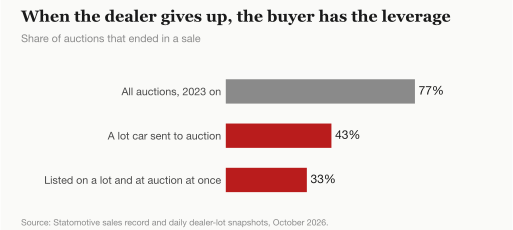
The lot helps in two more places. The first is a glut: the Porsche 992 Carrera has 1,347 listings against 155 auction sales a year, 111 months of supply, and the dealer is the one with leverage to lose. The second is when the dealer gives up. A lot car sent to auction sells only 43% of the time, 9% under its last ask. A car listed on a lot and at auction at the same time sells 33% of the time, against 77% for everything else. That no-sale is the opening of a deal, and the dealer knows it.
Add it up. The same car costs about a fifth more on a lot than it just sold for at auction, and after the buyer's fee and the truck the auction is still cheaper 97% of the time. The dealer mostly gets that number, and waiting for him to come down does not work. At auction his own cars bring 4% more and sell less often, and the 4% does not come back when you sell. On a $100,000 car the gap is about $26,000.
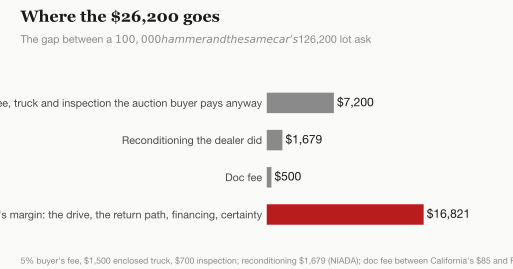
Of that, $7,200 is money the auction buyer spends anyway: the buyer's fee, the truck and the inspection. About $1,700 is reconditioning the dealer did and $500 is the paperwork. The remaining $16,800 is the dealer's margin, and it is the price of four things the auction does not sell: a car you can drive first, a return path backed by law in most states, financing on an old car, and the certainty that the car is yours when you want it. Those four cost the dealer about the same on a $30,000 car as on a $300,000 one, so the question is not auction or dealer. It is what the car costs. Under about $50,000 the dealer's layer is a few thousand dollars and buys more than that in inspection, transport and cover. Over $100,000 it buys the same services for five times the money, and the auction buyer who takes the inspection, the truck, the week of bidding and the one-in-five chance of no sale onto their own shoulders is paid tens of thousands for it.
Whichever way you buy, price the car against today's fair value, not last year's results, or the lot will look dearer than it is. And watch for the dealer's car that reaches the block: it sells 43% of the time, at 9% under his ask. That is where the two markets meet, and it is the buyer's best hour.
Every car in this report has a buyer's guide built from its complete sale record, 54 cars in all, with the cars for sale on dealer lots today priced against the same fair value. A free account lets you browse them and compare any two or three side by side on price, volume and trend. Premium opens every price driver on every car.
 Statomotive
