 Statomotive
2022-23 to 2025-26
+40% to +55%
When we ran this report, our record held 51 cars and about 19,000 sales. With that many, we can test the stories this market tells about itself, and several of the most repeated ones are wrong. Mods pay on a driven car. An accident costs as much at 100,000 miles as at 10,000. The best-known fix on the 996 pays at most half what it is said to. Selling at no reserve now costs money. And the manual premium, said to be fading, is still growing.
Each of our cars, from the Honda S2000 to the Lamborghini Murcielago, has its own buyer's guide, built from every sale we can find. One guide can tell you what that car is worth and why. Fifty-one guides can do something none of them can do alone: when we spot something on one car, we can check whether it happens on the other fifty. If it happens on 40 of them, it is not a quirk. It is how this market works.
This report covers what holds up across all 51 cars, and where it disagrees with what has been written about this market this year.
For every sale we record everything we can: price, date, miles, model year, trim, gearbox, paint, interior, options, who sold it, where it sold, the window sticker if there was one, and every comment in the auction thread, more than 1.2 million of them. When the same car sold again, or turned up on a dealer's lot, we followed it there too.
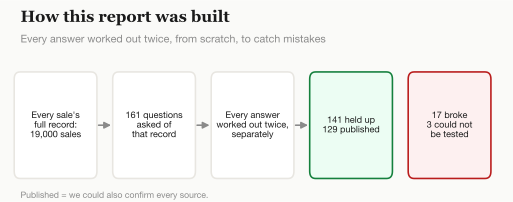
Then we asked 161 questions of that record, things like: does a manual still pay? Do dealers pay less at auction than private buyers? Does an accident matter less on a high-mileage car? Every answer was then worked out a second time, from scratch, to catch mistakes. 141 answers held up. We only publish the 129 where we could also confirm every source, and for each one we tell you how many of the cars agree.
Some answers did not hold up, and those are worth knowing too. Wood trim is not a hidden premium on BMWs. Bigger-than-standard wheels add nothing measurable (smaller ones cost about 3% an inch). And a manual is not worth more on an older car than on a newer one.
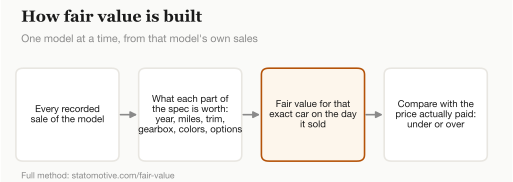
A word on fair value, since much of what follows leans on it. For every car we cover we start with every recorded sale: price, date, mileage and the full build sheet. Then we work out what each of those things is worth, one model at a time, so an E46 is only ever compared with other E46s. Fair value is what that exact car, with its miles and spec, should have sold for on the day it sold. Here is the full method. Premiums in this report compare cars sold in the same period, so inflation cancels out. Where a price moves over time, we say whether it is before or after inflation.
The manual premium is not fading. Last month's report showed the manual premium hitting 42% this year across 17 cars. One widely read analysis says the opposite. In March, RennPulse looked at more than 300 Porsche 911 sales over eight months and concluded that "the manual premium has shrunk ~3-5% year-over-year for the last three years across all generations." So we put their question to our own seven Porsches that were sold with both a manual and paddles or an automatic, with miles, model year and trim held the same. A manual was worth 14% more in 2022, 21% in 2023, 17% in 2024, 24% in 2025 and 29% in 2026 so far. Comparing 2022-23 with 2025-26 car by car, it went up on all six cars with enough sales: the 997 Turbo from 40% to 55%, the 996 Turbo from 15% to 33%, the 996 Carrera from 18% to 31%. (RennPulse's own 996 figure, "+29%", matches ours.)
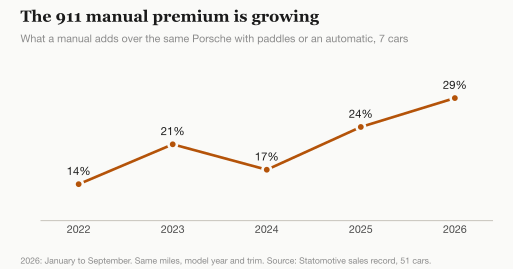
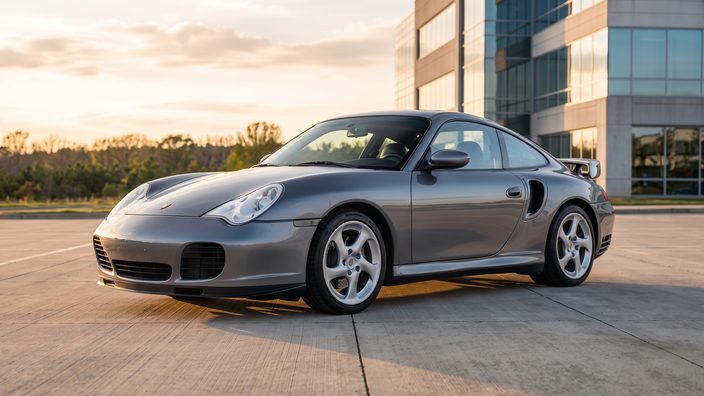
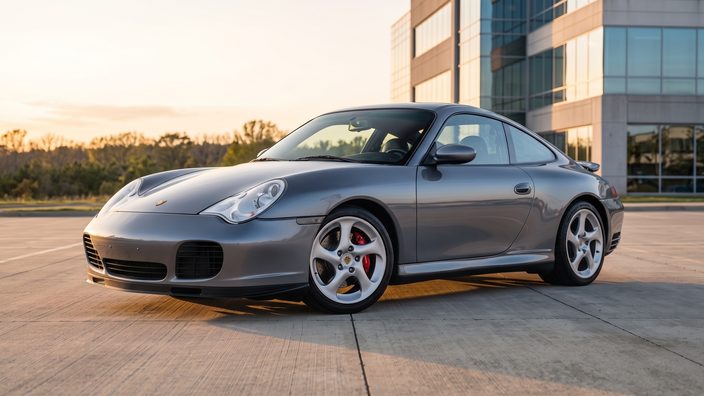
Eight months of one model family pointed one way. Eight years of sales on seven cars point the other way, and so do the 17 cars in last month's report.
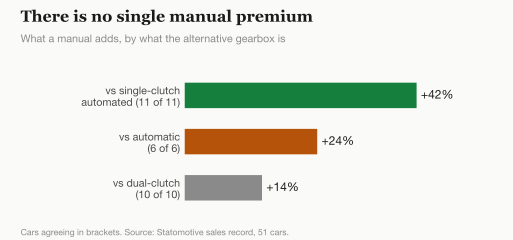
There is no single manual premium. The figure that gets quoted is one number. It is really three, depending on what the alternative is. Against the single-clutch automated gearboxes of the 2000s (the F1 and E-Gear boxes, SMG), a manual is worth 42% more, on 11 of 11 cars. Against a conventional automatic, 24%, on 6 of 6. Against a modern dual-clutch, 14%, on 10 of 10. Buyers are not paying for three pedals so much as paying to avoid the old automated boxes.
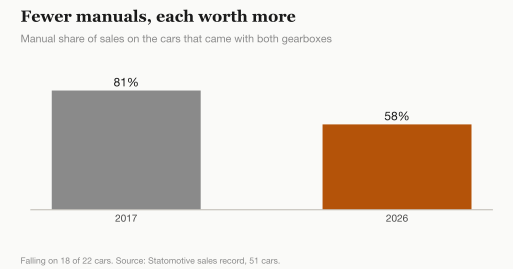
And the manuals are getting scarcer as they get dearer. On the cars that came both ways, manuals were 81% of sales in 2017 and 58% in 2026, falling on 18 of 22 cars. MyCarQuest's read of Monterey called the manual Ferraris "especially hot", with a six-speed F430 at $841,000. In our record a manual F430 sells for about 110% more than the same car with the F1 gearbox: roughly double. That gap eased by 12 points in the last 12 months. The F430 is one of five cars where the premium narrowed; it widened on 16. From a premium that large, a small step back is a market settling, not cooling on the stick.
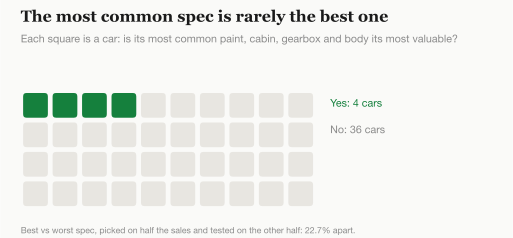
Buyers pay for the whole spec, not one part. Pick the best and worst combinations of paint, interior, gearbox and body on half of each car's sales, then test them on the other half: the best still beats the worst by 22.7%, on 30 of 40 cars. And each car's most common combination is its most valuable on only 4 of 40 cars.
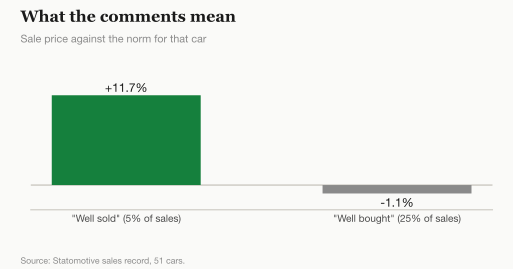
In the comments, "well sold" means something. "Well bought" does not. "Well sold" appears on 5% of sales and marks cars that sold for 11.7% above the norm for that car, on 20 of 23 cars. "Well bought" appears on 25% of sales and marks nothing at all (-1.1%). 73% of winning bidders never comment before the close, and the ones who do comment pay the same as those who don't, in threads of the same size. 1,213 people have won two or more of these cars; together they account for 22.8% of sales and pay 2-3% more.
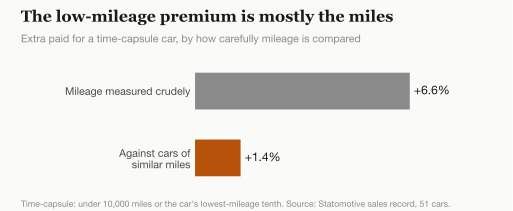
The low-mileage premium is smaller than it looks. Cars under 10,000 miles, or in their car's lowest-mileage tenth, seem to pay 6.6% extra when mileage is measured crudely, as one straight line. Compare them with cars of genuinely similar miles and the extra is 1.4%. Most of the "time-capsule premium" is simply the mileage effect, which is already steep: doubling the miles costs about 18% in 2025-26.
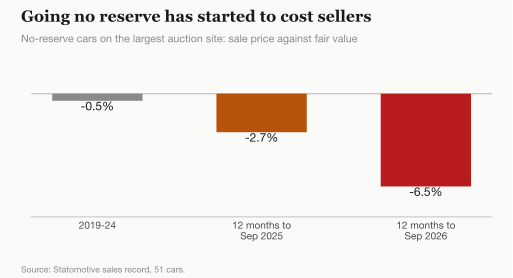
Going no reserve has started to cost sellers. The common advice is that dropping the reserve brings out the bidders. A Corvette-by-Corvette comparison on the largest site found the opposite: "Reserve auctions have done it 17 times", against 10 for no reserve. Our record points the same way, and the cost is growing. Before 2025, cars sold at no reserve went for almost exactly fair value, 0.5% under it. In the 12 months to September 2025 they went for 2.7% under, and in the last 12 months 6.5% under. We do not yet know why. The obvious test, the same seller with and without a reserve, rests on too few sellers to say.
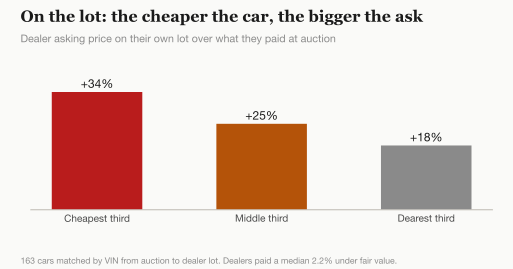
Last month's report followed dealers from the auction to their own lots: they are now close to half of all sellers on the largest auction site, they pay about fair value, and they ask about 23% more on the lot. Two things we can add this month. Those cars travel: 91% of them crossed a state line on the way to the lot, with California the largest net seller to dealers elsewhere and Illinois the largest net buyer, almost all of it the Chicago area. And on the lot, the cheaper the car, the bigger the asking markup over what the dealer paid: about a third on the cheapest cars, under a fifth on the dearest. Much of a dealer's cost is a flat dollar amount, so it is a bigger share of a cheap car. These are asking prices, not final sale prices, and they are slow to come down: 41% of cars listed for more than 90 days are asking the same or more than when they were first listed.
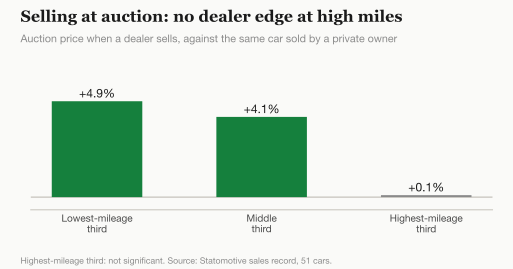
Selling at auction, dealers get no edge on high-mileage cars. This is a different measure from the lot markup above: the price a car sells for at auction when a dealer is the seller, against the same car sold by a private owner. On a car's lowest-mileage third, buyers pay dealers 4.9% more. On its highest-mileage third, 0.1%: nothing. Whatever buyers pay a dealer for, they stop paying it once the miles are high.
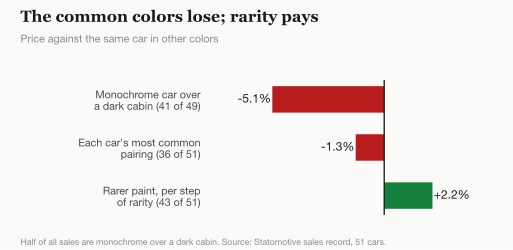
The common colors lose, and it is about rarity, not hue. iSeeCars' study of 1.2 million everyday used cars found that "gold, white, and black cars drop the most in value." Our record agrees, and shows why. Half of all our sales are a black, grey, silver or white car over a black or grey cabin, and they sell 5.1% under everything else, on 41 of 49 cars. Each car's single most common paint-and-cabin pairing sells below that car's average on 36 of 51 cars. What pays is rarity: the rarer a paint is on its model, the more it earns, about 2.2% each time it gets roughly three times rarer, on 43 of 51 cars. And paint and cabin simply add up. A "magic combination" worth more than its two parts showed up only as often as chance would predict.
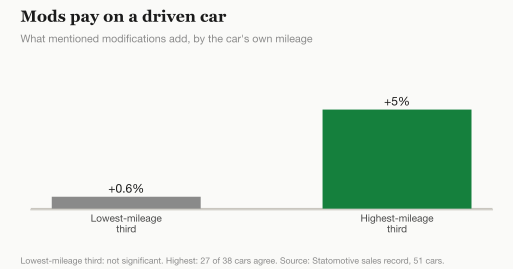
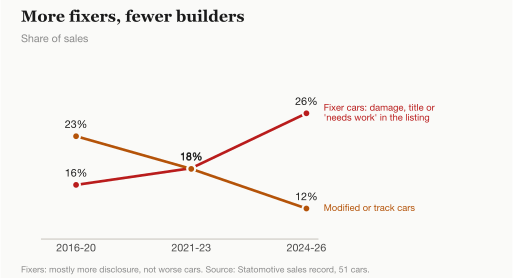
Modifications are not a death sentence on a driven car. Jalopnik's advice is the standard view: "an unmodified version of the same car will almost always sell for more cash." Split each car by its own mileage and the picture changes. On the lowest-mileage third, mentioned modifications make no difference (+0.6%, within the noise). On the highest-mileage third they add about 5%, on 27 of 38 cars. Buyers of a car built to be driven pay for the parts. There are fewer such cars each year, though: modified and track cars were 22.8% of sales in 2016-20 and 11.5% in 2026.
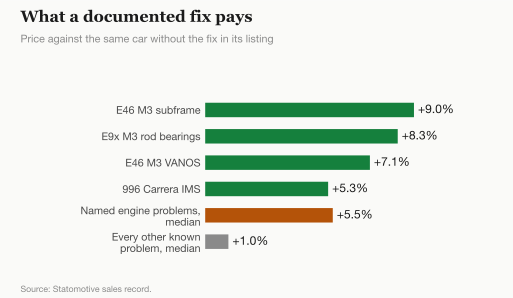
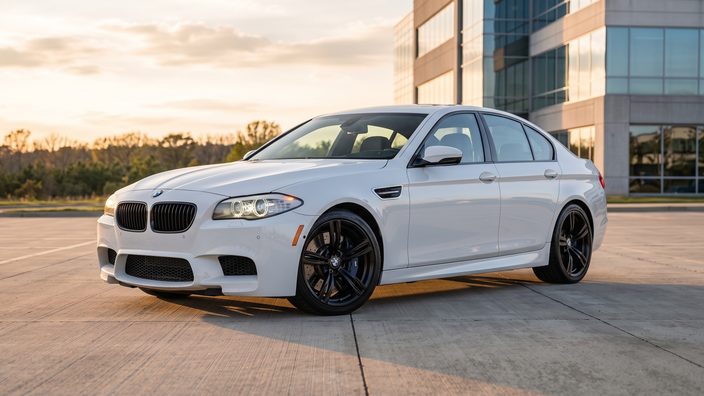
A known engine fix pays, but less than the forums promise. A documented fix of a car's signature engine problem (rod bearings, IMS, rear main seal, VANOS, the E46 subframe) pays a median 5.5%, against 1.0% for every other known problem. By car: E9x M3 rod bearings +8.3%, E46 subframe +9.0%, E46 VANOS +7.1%, and the 996 IMS +5.3% across all years. RennPulse in June put a documented 996 IMS retrofit at $5,000 to $10,000 on an average car of $28,759, which is 17% to 35%. Even in recent sales, where it pays most, we measure 8.9% for 2024-26, and 5.0% in 2026 alone, on too few sales to be sure. The fix pays, but at most half what it is said to.
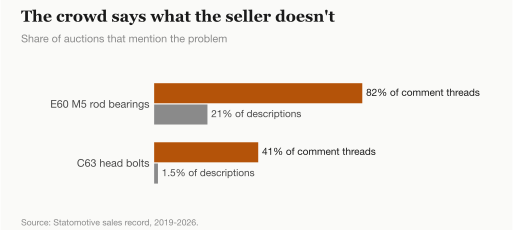
Sellers stay quiet about problems; the crowd doesn't. E60 M5 rod bearings come up in 82% of auction threads and 21% of descriptions. C63 head bolts, 41% against 1.5%. Some problems are almost never named at all: the F8x M4 crank hub in 1% of listings, the AMG GT steering rack in none of 421. After engine failures in 2014, Porsche fitted new engines to all 785 GT3s built to that point; only 8 of the 40 listings for 2014 GT3s in our record say so.
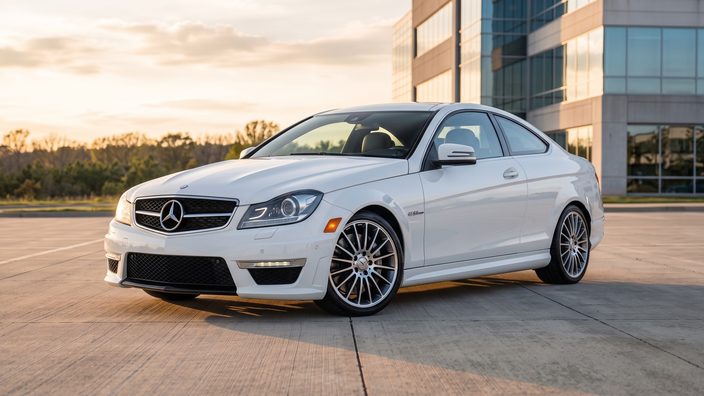
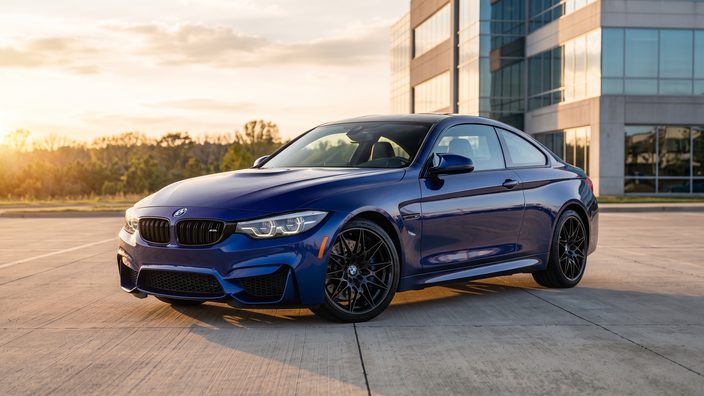
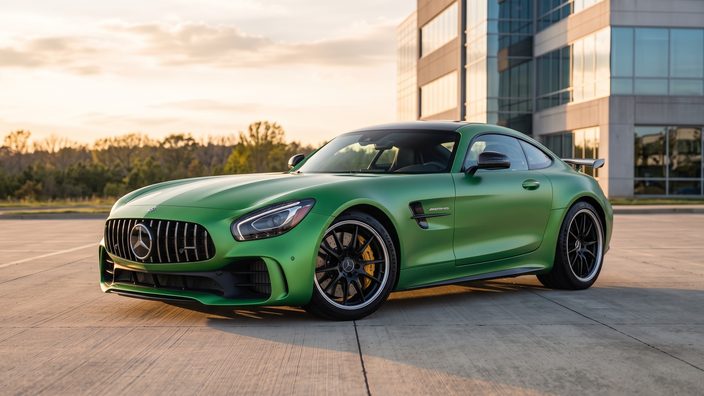
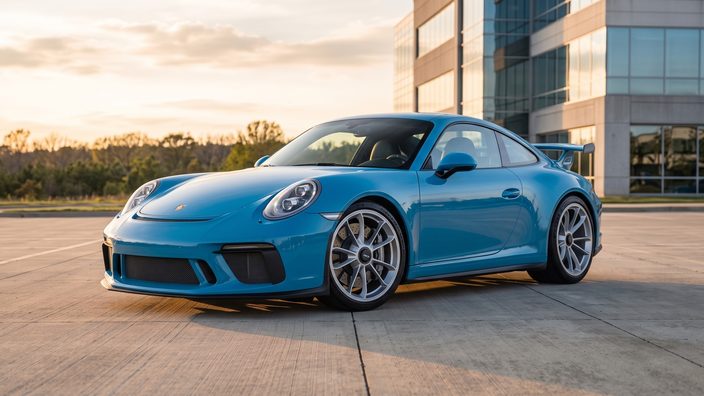
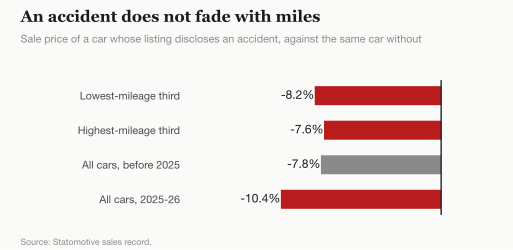
An accident costs about the same at 100,000 miles as at 10,000. A common piece of advice, repeated in a consumer report quoting an appraiser, is that past 100,000 miles "an accident has very little impact on value." Counting only listings that disclose an accident, not other damage, it costs 8.2% on a car's lowest-mileage third and 7.6% on its highest. It does not fade. And the discount is growing: 7.8% before 2025, 10.4% in 2025-26.
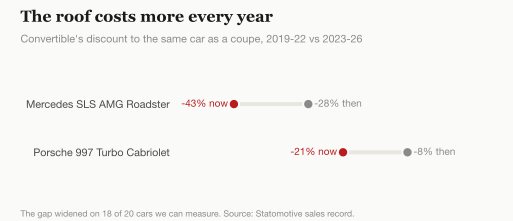
The roof keeps costing more. Last month we showed the convertible's discount to the coupe widening on 18 of 20 cars. That is the opposite of the old auctioneer's line, "when the top goes down, the price goes up", and of Hagerty's 2023 finding that "convertibles do sell for premiums over coupes." Nothing in this month's record changes it.
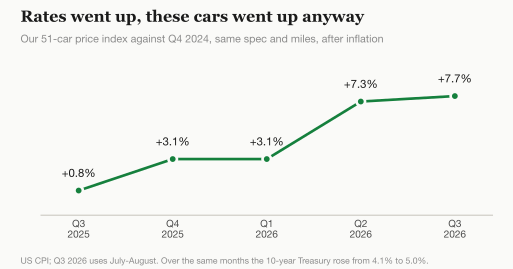
Rates went up and these cars went up anyway. The Fed raised its target range by a quarter point on September 16. Two days later, Cox Automotive reported that the slide in wholesale used-car prices was "enough to tip the year-over-year comparison negative for the first time in 2026." Over the 12 months to September, with the same model, year, spec and miles compared, our cars rose 8.3% before inflation and 5.2% after it, with 38 of 51 cars up after inflation. Measured from the end of 2024 instead, the rise is 7.7% after inflation, as the chart shows. Over the same months the 10-year Treasury yield rose from about 4.1% to 5.0%. That is one stretch of time, one shock, not 51 separate confirmations. It says rising rates did not stop this rise. It does not say rates no longer matter.
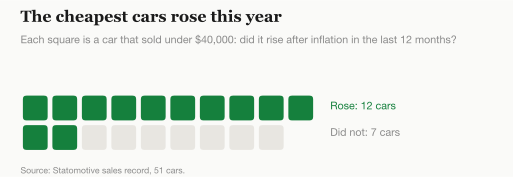
The typical car is not falling in real terms this year. Hagerty's August market report says "the typical enthusiast with the typical car is operating under completely different dynamics, with values often falling in real terms." For the cheapest cars in our record, the opposite was true this year: 12 of the 19 cars that sold under $40,000 rose after inflation. As last month's report showed, they are still below where they were in 2022, so Hagerty's longer view still holds for them. The top is where the records are: after inflation, 12 cars sold at or above any earlier 12-month level, including the F355, Murcielago, Gallardo, 458, Ford GT, GT-R and the 996 and 997 Turbos.
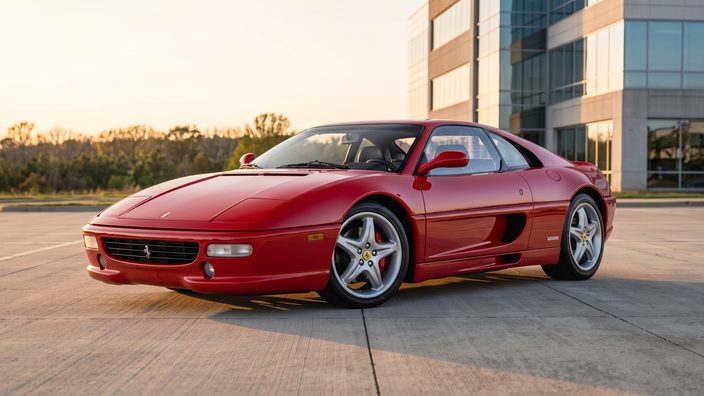
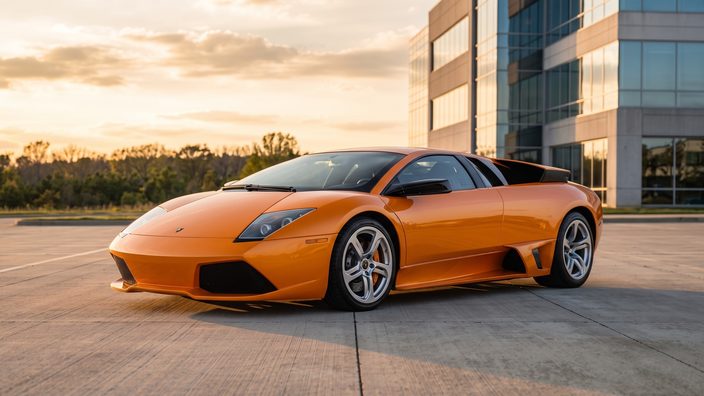
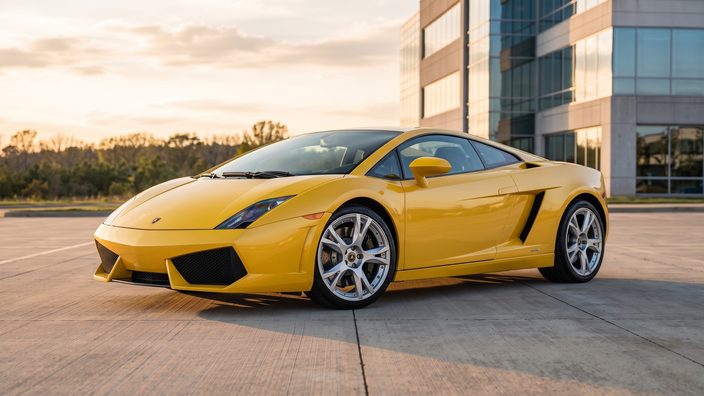
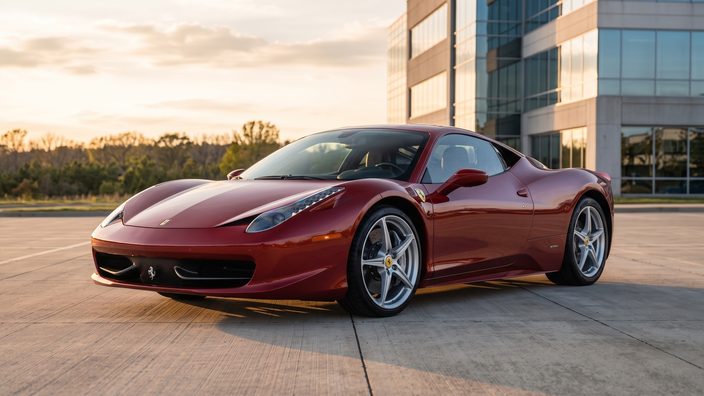
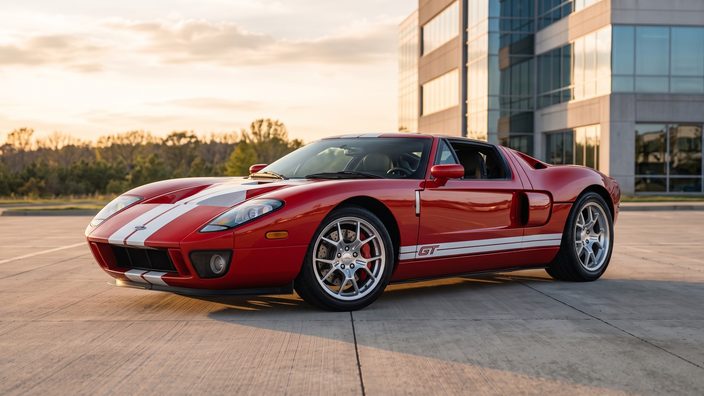
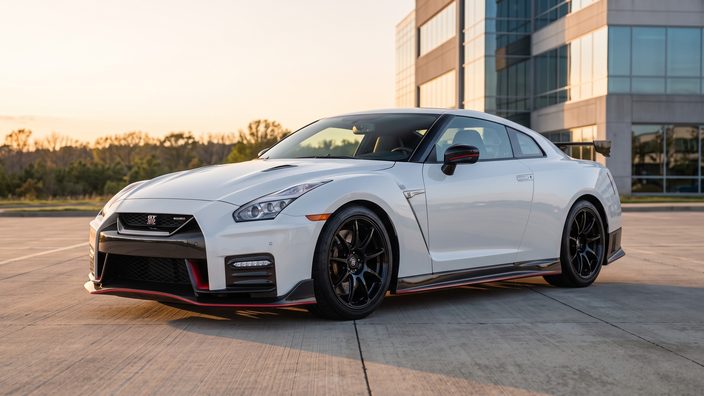
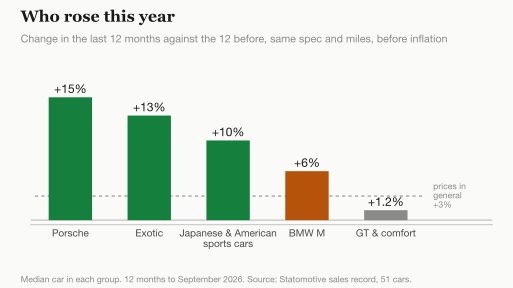
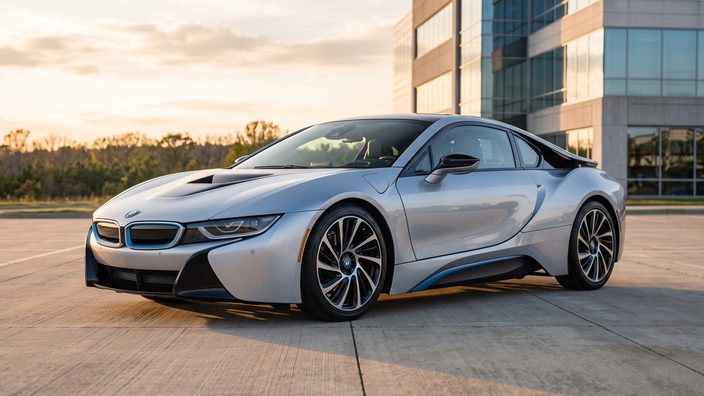
"Modern" is not one market. Heritage's Q3 report found the middle soft: "241 of 467 verifiable lots sold below their low estimate, and 148 of those cost under $150,000." Within our 51, the split is by kind of car more than by age. Porsches rose 14.8% and exotics 12.6% before inflation. The ten GT and comfort cars rose 1.2%, are still 12.7% below their 2019-24 average in dollars, and not one is at a high. The BMW i8 is the one car with a clear fall.
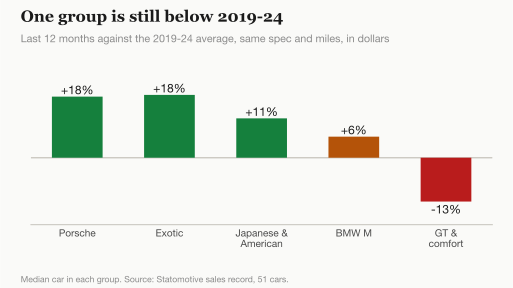
Why the split? This part is our read. The two groups are bought for different reasons by different people. The cars at highs are collector cars: built in small numbers (Ford made 4,038 GTs in total) and from an era that is over, with gated manuals and naturally aspirated engines. They are bought as scarce objects, often with money that grew in the stock market, and the S&P 500 returned 15% over the same 12 months. The GT and comfort cars were built as luxury transport. They are shopped as cheap used luxury, often on finance, so higher rates hit their buyers directly, and they are worth what they cost to run, not how rare they are. Dealers are struggling to move them: 41% of the GT and comfort cars on dealer lots have been listed for more than six months, the most of any group.
What sellers are now willing to say. Listings describing damage, a non-clean title or a car that needs work were 15.8% of sales in 2016-20 and 27.2% in 2026. That is mostly disclosure, not worse cars: on the largest site, quoting a damage entry from the history report became routine from 2024.
We ranked all 50 cars with enough history using the signals that have predicted the following year in our own record, then tested it at six past dates, using only what was known at each one. The top ten beat the bottom ten over the next 12 months at five of six dates, by 4.9 points on average.
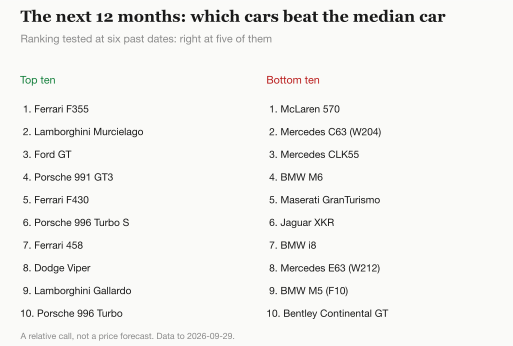
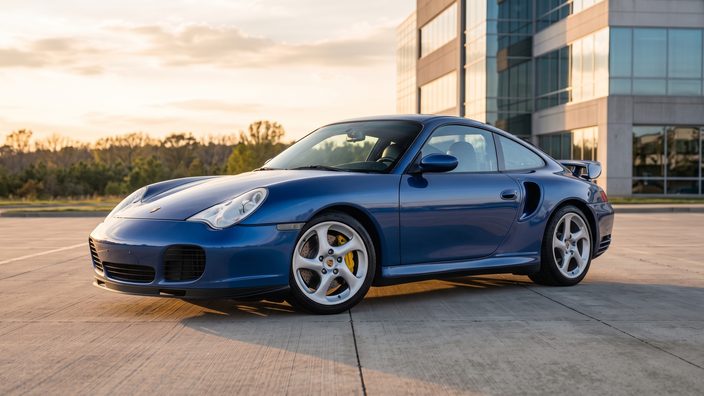
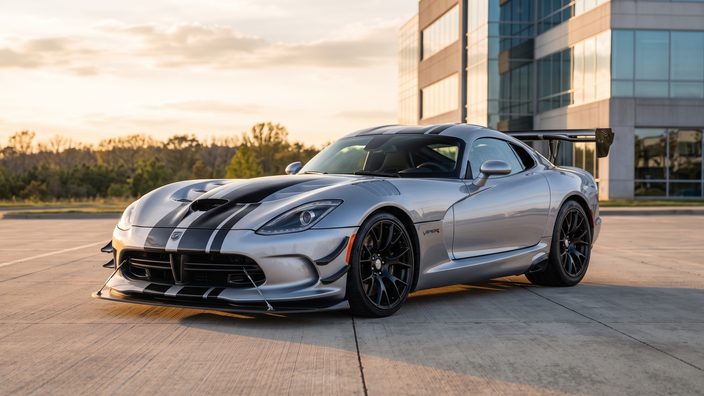
The top ten for the next 12 months: the F355, Murcielago, Ford GT, 991 GT3, F430, 996 Turbo S, 458, Viper, Gallardo and 996 Turbo.
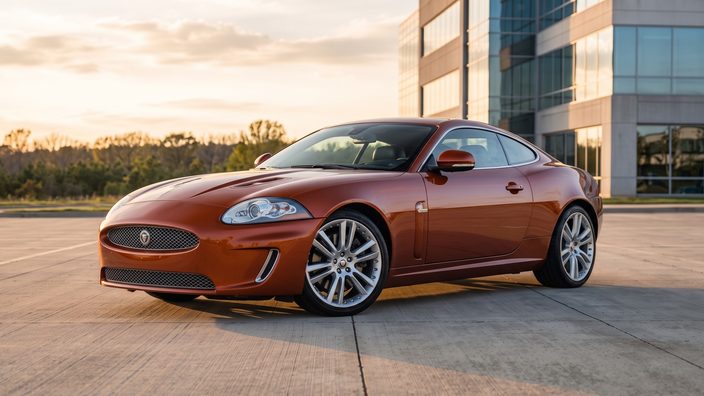
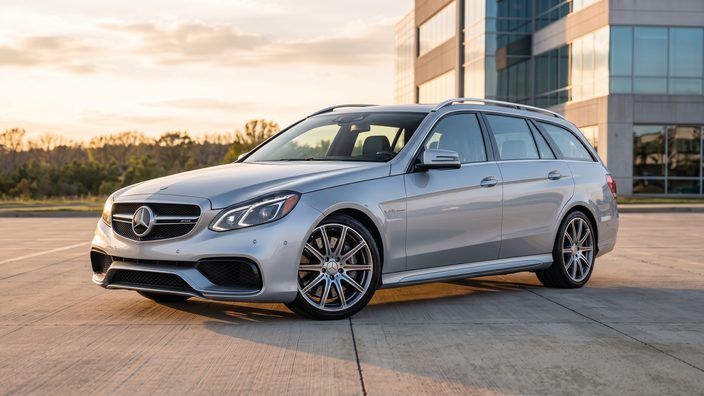
The bottom ten: the McLaren 570, C63 (W204), CLK55, M6, GranTurismo, XKR, i8, E63 (W212), M5 (F10) and Continental GT. This ranks cars against each other. It is not a price forecast.
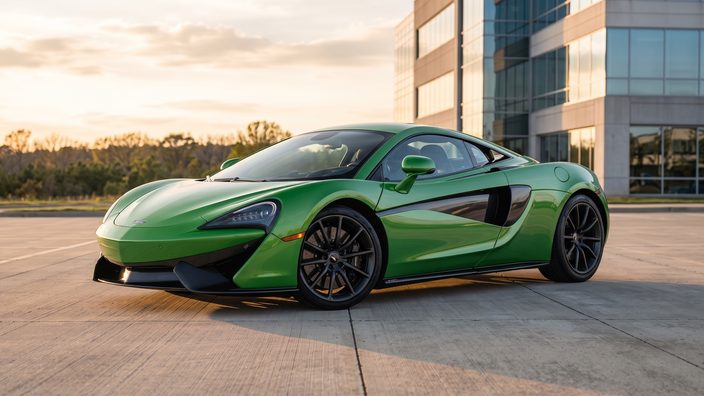
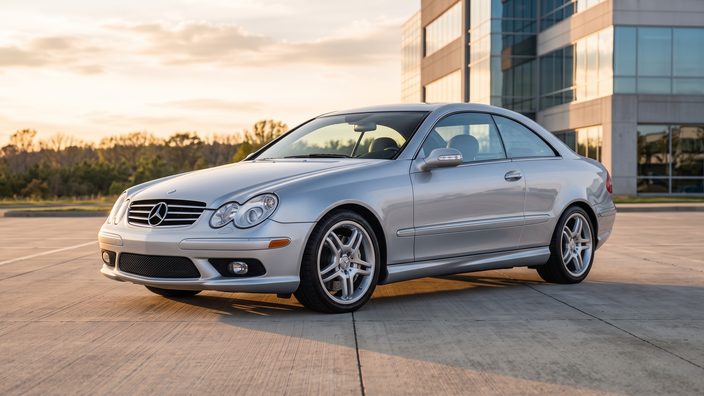
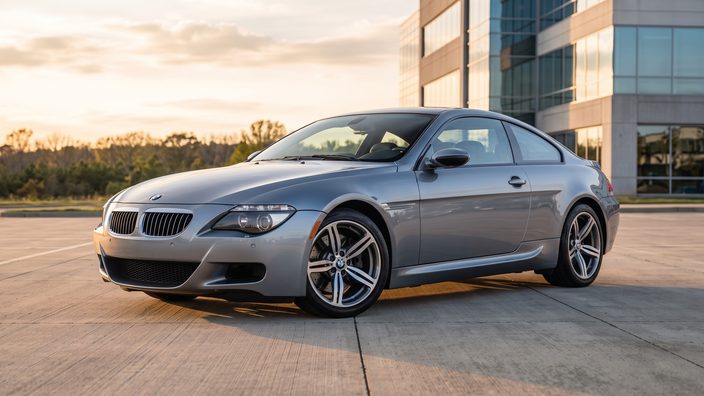
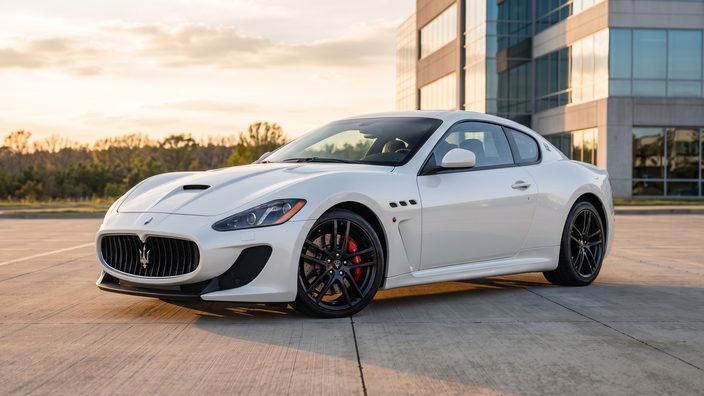
Two things would tell us we are wrong. If the manual premium in the first half of 2027 comes in below 30%, this year's jump was a spike, not a step. And if our 51-car index for the fourth quarter of 2026 comes in below the third, the run-up is turning. We will report both.
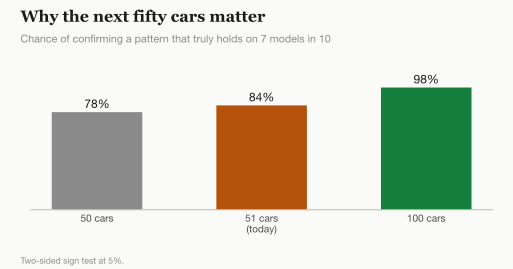
Every finding in this report is a count of cars that agree, and that count is what compounds. One car can tell you a price. Ten can suggest a pattern. At fifty-one, a pattern that truly holds on seven models in ten gets confirmed about 78% of the time. At 100 cars, 98%. Several findings we tested this round, such as whether a fix pays most on the cars where it is rarest, did not hold up at this size. More cars will settle them.
Most of what gets written about this market is written from one car, one sale or one auction weekend. Each of those can be right. But they can't be checked, and this year several of the most repeated ones were wrong: mods pay on driven cars, an accident costs the same at any mileage, the famous fixes pay less than promised, no reserve now costs sellers money, and the manual premium is still growing. Fifty-one cars is enough to see that. A hundred will be enough to see what we can't yet.

